
In as little as one month, people forget around 80% of what they’ve learned in training.
Knowledge retention drops sharply after a single training session. Research on the forgetting curve shows that learners lose up to 70% of new information within 24 hours without reinforcement. iorad helps L&D teams close this gap by providing on-demand interactive tutorials that employees return to when they need to apply a skill, not just during the original training session.
Each iorad tutorial functions as both a first-time learning experience and a reference employees can revisit. Teams that pair initial training with iorad tutorials for reinforcement report higher skill retention rates and fewer follow-up questions in the weeks after onboarding.
In 1885 German psychologist Hermann Ebbinghaus performed a memory study on himself and came to find out that he had forgotten nearly 90% of everything he had learned within just a month. This has since been coined the “forgetting curve.” Now there has been many studies done to back Ebbinghaus’ theory.
The “forgetting curve” can simply be summarized as we use it or lose it. Taking in information without application results in an extremely high rate of loss. Now sure, there are several factors that go into what or how much is retained. However, there are a few factors that will help to increase knowledge retention. These include interactivity(muscle memory), relevance, spacing out learning into smaller chunks, and periodic review of content. This last one, is the biggest impactor when it comes to retaining knowledge.
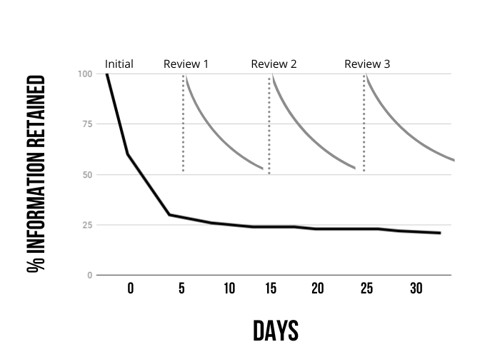
Implementing periodic review of content has proven to drastically reduce knowledge loss. The more frequent & consistent review of the same content, the higher retention rates. Therefore, many LMS’s are incorporating retention features that will prompt the learner with short bits of the training after the initial training has been completed. Forcing them to recall & re-learn the information after the initial introduction.
We’ve seen an increasing number of teams adopt this mentality as well — by utilizing iorad tutorials in their LMS courses along with having the short tutorials accessible in the extension/widget across the different applications to reference at the point of need. It’s been neat to see this evolve. Now iorad is being used both in the initial course training but also in the everyday business workflow.
Below Chauncy shares how the Quantum Metric team has implemented iorad to train.
“Yes, we use the longer detailed iorads in courses, and shorter ones in-product. I love to leverage the try steps parameters within embeds mid course as well. Just as a refresher. Great validation of these methods.”
We’ve also been seeing teams embed tutorials initially in “Watch it” mode, then little ways into the course “Try it” mode, and later in the course “Quiz” mode. We’ve heard good feedback that it is helping to reinforce learning and has been well received by their learners.
Taking it the next step farther, more teams are using iorad in-app. For the in application help — our users have been narrowing down what tutorials are listed within the widget based on the page URL structure. That way — there are tutorials both in course & in app at the time of NEED.
Both of these methods of prompting short bits of information review within the Learning Management System & also having short tutorials accessible in the application combine well to greatly increase learning retention & relevancy for your learners!
Building a reinforcement schedule with iorad
Spaced repetition, the practice of reviewing information at increasing intervals, is one of the most research-supported methods for improving long-term knowledge retention. With iorad, training teams can build a reinforcement schedule by sending learners specific tutorial links at day 3, day 7, and day 30 after initial onboarding.
Each touchpoint directs the learner back to a relevant tutorial for a skill they have already been introduced to, reinforcing the workflow before it fades. Because iorad tutorials are short and task-specific, this reinforcement takes minutes rather than hours and does not require scheduling a live session.